How this concrete calculator works
Enter the shape (slab, footing, or steps), dimensions, and optional waste percent. The tool returns volume in cubic feet, cubic yards, and cubic meters, plus bag counts for common 40, 60, and 80 lb mixes. All math runs in your browser—inputs are not uploaded.
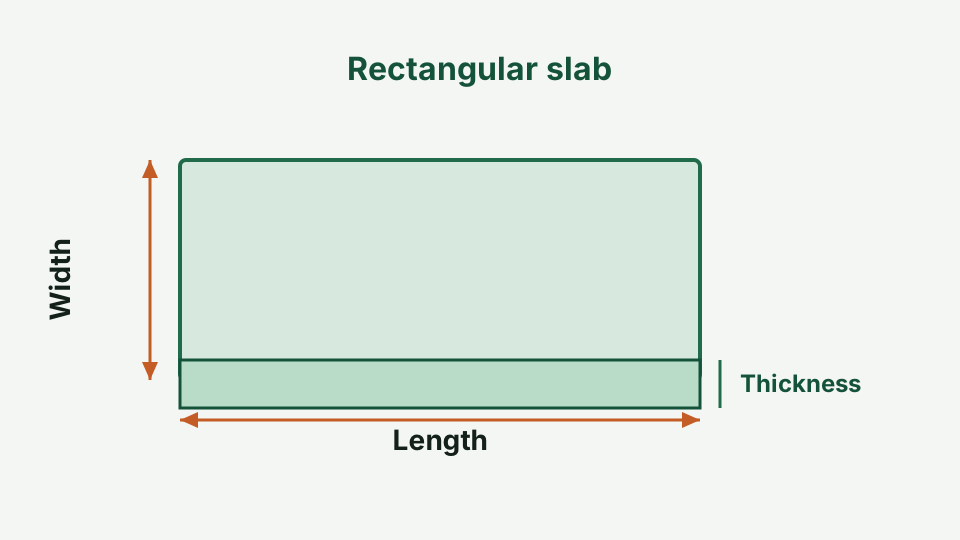
Use feet (or meters) for length and width. Enter slab thickness in inches (or centimeters). The calculator converts everything to a consistent unit system before multiplying, which prevents the classic mistake of treating a 4-inch slab as 4 feet thick.
How it's calculated
- Slab / footing: volume = length × width × thickness (all in feet)
- Solid steps: volume = width × tread × riser × n(n+1)/2
- Bags: bags = ceil(volume_cu_ft ÷ bag_yield)
Bag yields used here follow common QUIKRETE / Sakrete published coverage: about 0.30 cu ft (40 lb), 0.45 cu ft (60 lb), and 0.60 cu ft (80 lb). Always check the bag you buy—lightweight and high-strength mixes can differ.
Worked example: 10×10 patio slab
A 10 ft × 10 ft slab at 4 inches thick is 10 × 10 × (4÷12) = 33.33 cu ft ≈ 1.23 cu yd. With 10% waste → 36.7 cu ft. That is ceil(36.7 ÷ 0.60) = 62 bags of 80 lb mix or ceil(36.7 ÷ 0.45) = 82 bags of 60 lb mix (QUIKRETE Concrete Mix yields of about 0.60 / 0.45 cu ft per bag). Ready-mix starts to make sense near or above one cubic yard when access allows a truck. More sizes: how much concrete for a 10×10 slab.
| Bag size | Approx. yield | Bags per cu yd |
|---|---|---|
| 40 lb | 0.30 cu ft | ~90 |
| 60 lb | 0.45 cu ft | ~60 |
| 80 lb | 0.60 cu ft | ~45 |
Choosing slab thickness
Many residential patios and shed pads use 4 inches of concrete over compacted base. Driveways and heavier loads often need 5–6 inches plus reinforcement details required by local code. This calculator estimates concrete volume only—it does not design structural thickness, rebar, or base depth.
Waste factor tips
Uneven subgrade, form bulge, and spillage routinely consume 5–10% extra. DIY bag mixes benefit from the higher end of that range. Order a little more rather than finishing a pour short; cold joints and mismatched batches are hard to hide.
| Thickness | Volume + waste | 80 lb bags | 60 lb bags |
|---|---|---|---|
| 4 in | ~36.7 cu ft | 62 | 82 |
| 6 in | ~55.0 cu ft | 92 | 123 |
Gravel or crushed-stone base under the slab is ordered separately—use the gravel calculator. Regional frost depth and soil type change how thick that base should be; this tool does not size base for your climate.
Common mistakes
- Mixing inches and feet in the same product (4 must mean 0.333 ft for thickness).
- Forgetting that gravel base is separate from concrete volume.
- Ordering exact yardage with no waste on rough soil.
- Ignoring manufacturer yield notes on specialty mixes.
- Using this slab tool for fence post holes or Sonotubes—use the dedicated calculators instead.
Related long-tail jobs
For fence posts use the post hole concrete calculator. For cardboard forms use the Sonotube calculator. Read how many bags of concrete do I need for bag charts.
Assumptions and limits
The concrete calculator results are planning estimates for rectangular or cylindrical shapes with uniform depth. Real sites have slopes, voids, and product variation. Always confirm coverage with the manufacturer label and local building practices before you buy large quantities.
Unit toggles switch input labels between US imperial and metric. Shareable URLs store your inputs in the query string for convenience, while the canonical tag stays on the clean page URL so search engines do not index every parameter combination.
Shopping checklist
- Write down the calculator outputs (volume, bags, or piece counts) and round up for waste.
- Call your supplier for density, dye lot, or delivery minimums when ordering bulk material.
- Check access for trucks, wheelbarrows, and staging space before delivery day.
- Photograph existing conditions so you can revisit dimensions if a helper measures differently.
FAQ
How many 80 lb bags of concrete in a yard?
One cubic yard is 27 cubic feet. At about 0.60 cu ft per 80 lb bag, you need roughly 45 bags per cubic yard (27 ÷ 0.60), before waste.
Should I order ready-mix or use bags?
Bags are practical under about 1 cubic yard. Larger pours are usually cheaper and more consistent with ready-mix delivered by the yard.
How thick should a concrete slab be?
Many residential patio and shed slabs use 4 inches. Driveways and heavier loads often need 5–6 inches plus proper base—confirm with local code.
What waste factor should I use?
A 5–10% waste factor covers uneven subgrade, spillage, and over-excavation. Use 10% for DIY bag mixes and irregular forms.
Related guides
- How Many Bags of Concrete Do I Need?
- How Much Concrete for a 10×10 Slab?
- How Much Concrete for Fence Posts?
Sources
- QUIKRETE – Concrete calculator & bag yields Used for: 40/60/80 lb bag yield planning figures and coverage checks. Checked .
- Sakrete – Concrete calculator Used for: Cross-check bag coverage estimates for bagged concrete. Checked .
- American Cement Association (formerly PCA) Used for: Industry context on cement and concrete materials. Checked .
- ACI 332.1R-18 preview – Guide to Residential Concrete Construction Used for: Residential concrete practice overview (preview PDF). Checked .
Estimates only—confirm bag yields on the product label and check local building codes before you pour or order. Not affiliated with QUIKRETE, Sakrete, Sonoco, or any manufacturer named in the sources. Found an error? Tell me.
Calculator version 1.0 · Changelog