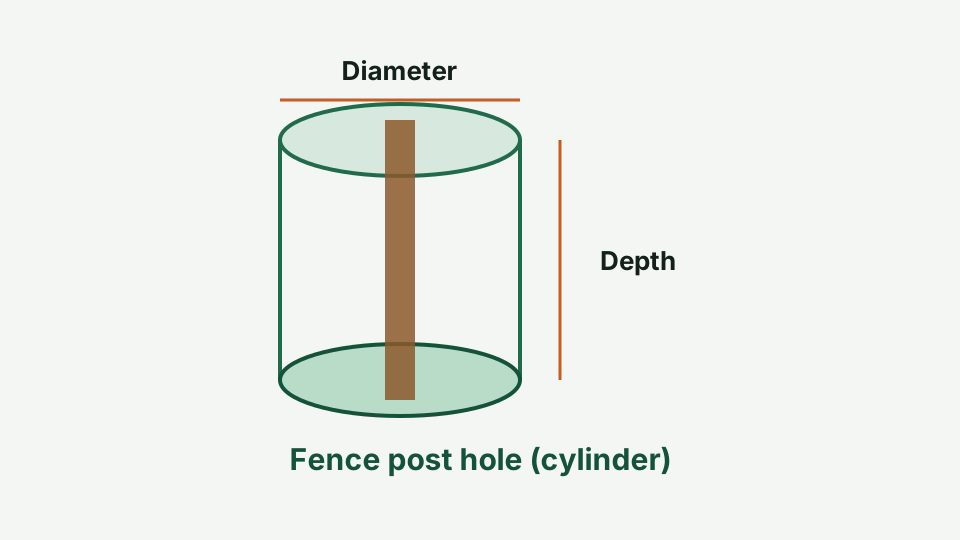
Post hole concrete formula
Treat each hole as a cylinder. Convert diameter to feet, then volume (cu ft) = π × r² × depth × posts. Example: 10 posts, 10" diameter (r = 5/12 ft), 30" deep (2.5 ft): π × (5/12)² × 2.5 × 10 ≈ 13.6 cu ft (~0.50 cu yd).
Hole diameter is often about three times the post width for wood posts, but wind load, frost depth, and panel weight matter more than rules of thumb. Dig below the local frost line when frost heave is a concern, and slope the top of the concrete so water drains away from the post.
Typical bag counts
| Hole | ~Volume | 80 lb bags each |
|---|---|---|
| 8" × 2 ft | 0.70 cu ft | 2 |
| 10" × 2.5 ft | 1.36 cu ft | 3 |
| 12" × 3 ft | 2.36 cu ft | 4 |
Worked example: 48 ft privacy fence
At 8 ft post spacing you need 7 posts (6 sections + end). If each hole is 10" × 2.5 ft, one hole is ~1.36 cu ft. Seven holes ≈ 9.55 cu ft before waste, about 10.5 cu ft with 10% waste—roughly eighteen 60 lb bags or fifteen 80 lb bags. Cross-check post count with the fence calculator.
Concrete vs gravel-set posts
Both methods are used. Concrete holds posts rigidly for privacy panels; gravel can improve drainage in some soils. Follow wood-preservative requirements for ground contact and any HOA or code rules in your area.
Common mistakes
- Using interior patching compound instead of outdoor concrete or setting mix.
- Leaving a water pocket against the post by crowning concrete the wrong way.
- Under-digging frost depth on gates and end posts that take more load.
More detail: How much concrete for fence posts.
Assumptions and limits
The concrete calculator post holes results are planning estimates for rectangular or cylindrical shapes with uniform depth. Real sites have slopes, voids, and product variation. Always confirm coverage with the manufacturer label and local building practices before you buy large quantities.
Unit toggles switch input labels between US imperial and metric. Shareable URLs store your inputs in the query string for convenience, while the canonical tag stays on the clean page URL so search engines do not index every parameter combination.
Shopping checklist
- Write down the calculator outputs (volume, bags, or piece counts) and round up for waste.
- Call your supplier for density, dye lot, or delivery minimums when ordering bulk material.
- Check access for trucks, wheelbarrows, and staging space before delivery day.
- Photograph existing conditions so you can revisit dimensions if a helper measures differently.
FAQ
How much concrete for one fence post?
It depends on hole diameter and depth. An 8″ × 2 ft cylinder is about 0.70 cu ft (two 80 lb bags of standard mix after waste). A 10″ × 2.5 ft hole is about 1.36 cu ft (three 80 lb bags after waste). Fast-Setting dry-pour products may list fewer bags—follow that label, or use this calculator for a full fill.
Do I fill the whole hole with concrete?
Many residential fences use concrete around the post to near grade, or a gravel base with concrete collar. Follow local frost-line depth and manufacturer guidance.
Should posts be set in gravel or concrete?
Both methods are used. Concrete holds posts rigid; gravel can improve drainage in some soils. Check local code and wood-preservative requirements for ground contact.
Related guides
Sources
- QUIKRETE – Setting a fence post Used for: Practical post-setting steps and bagged concrete context. Checked .
- QUIKRETE – Concrete calculator Used for: Bag yield cross-check for cylinder volumes. Checked .
- Clemson HGIC – Home & Garden Information Center Used for: Landscape and fencing extension resources. Checked .
Estimates only—confirm bag yields on the product label and check local building codes before you pour or order. Not affiliated with QUIKRETE, Sakrete, Sonoco, or any manufacturer named in the sources. Found an error? Tell me.
Calculator version 1.0 · Changelog