Column volume method
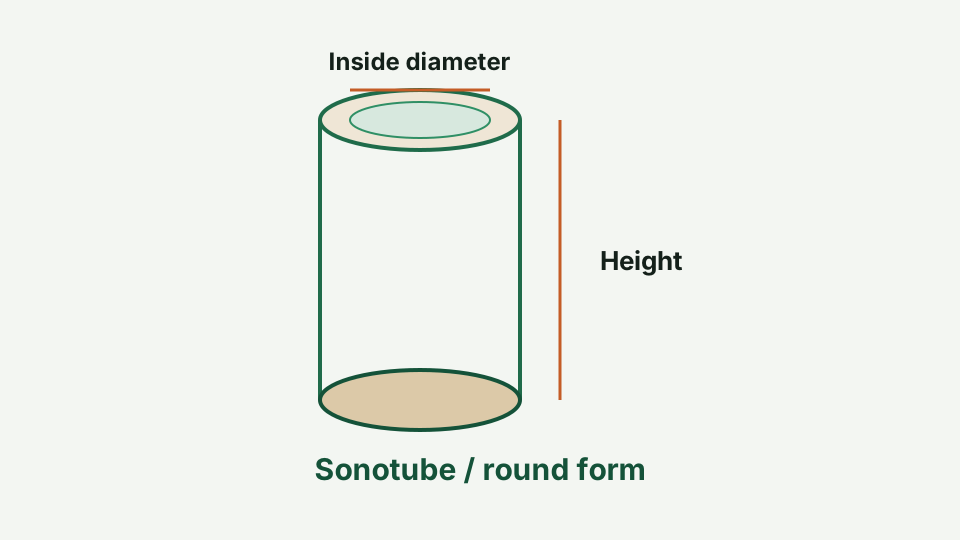
Sonotube and similar round cardboard forms use the cylinder formula: π × (inside diameter ÷ 2)² × height × count. Use the inside diameter printed on the form. Height is the concrete column length you will fill—not necessarily the full tube length if you stop short.
Worked example
Four 10" Sonotubes, each 3 ft: diameter 10" → r = 5/12 ft. Volume each = π × (5/12)² × 3 ≈ 1.64 cu ft. Four tubes ≈ 6.54 cu ft (~0.24 cu yd). With 5% waste → 6.87 cu ft, which is ceil(6.87 ÷ 0.60) = 12 bags of 80 lb mix.
A 12" tube holds about 0.785 cu ft per foot of height. That means a 4 ft pier is roughly 3.14 cu ft—six 80 lb bags (or seven 60 lb bags) before waste—useful for deck footings when paired with proper footing bells or pads as required by code.
| Inside Ø | 3 ft deep | 4 ft deep |
|---|---|---|
| 8 in | 2 bags | 3 bags |
| 10 in | 3 bags | 4 bags |
| 12 in | 4 bags | 6 bags |
| 16 in | 7 bags | 10 bags |
Deck pier tips
Place tubes plumb on compacted base or footing details specified for your deck. Brace forms before pouring. For full framing takeoffs continue with the deck material calculator.
Common mistakes
- Using outside diameter instead of inside diameter.
- Forgetting to multiply by the number of piers.
- Pouring without bracing, which can ovalize thin forms.
Assumptions and limits
The sonotube concrete calculator results are planning estimates for rectangular or cylindrical shapes with uniform depth. Real sites have slopes, voids, and product variation. Always confirm coverage with the manufacturer label and local building practices before you buy large quantities.
Unit toggles switch input labels between US imperial and metric. Shareable URLs store your inputs in the query string for convenience, while the canonical tag stays on the clean page URL so search engines do not index every parameter combination.
Shopping checklist
- Write down the calculator outputs (volume, bags, or piece counts) and round up for waste.
- Call your supplier for density, dye lot, or delivery minimums when ordering bulk material.
- Check access for trucks, wheelbarrows, and staging space before delivery day.
- Photograph existing conditions so you can revisit dimensions if a helper measures differently.
FAQ
Is Sonotube diameter inside or outside?
Use the inside diameter (the clear form size) for concrete volume. Manufacturers label common sizes such as 8", 10", and 12".
How much concrete for a 12-inch Sonotube?
Per foot of height, a 12" tube needs about 0.785 cu ft. A 4 ft pier is ~3.14 cu ft—six 80 lb bags before waste (still six after the default 5% waste at 0.60 cu ft/bag).
Related guides
Sources
- Sonotube concrete forms – product sizing Used for: Inside diameter / form sizing for round tubes. Checked .
- QUIKRETE – Concrete calculator Used for: Bag counts from calculated cubic feet. Checked .
Estimates only—confirm bag yields on the product label and check local building codes before you pour or order. Not affiliated with QUIKRETE, Sakrete, Sonoco, or any manufacturer named in the sources. Found an error? Tell me.
Calculator version 1.0 · Changelog