How Much Concrete for a 10×10 Slab?
A 10×10 ft slab at 4 inches needs about 1.23 cubic yards (33.3 cu ft) before waste—roughly 62 bags of 80 lb mix or 82 bags of 60 lb mix after 10% waste. At 6 inches the same footprint is about 1.85 cu yd. Use these figures as planning estimates and confirm bag yields on the label.
This page is a size-specific worked chart. For arbitrary dimensions use the concrete calculator. It does not replace post-hole or Sonotube tools—see fence post concrete and bag yield charts for those shapes.
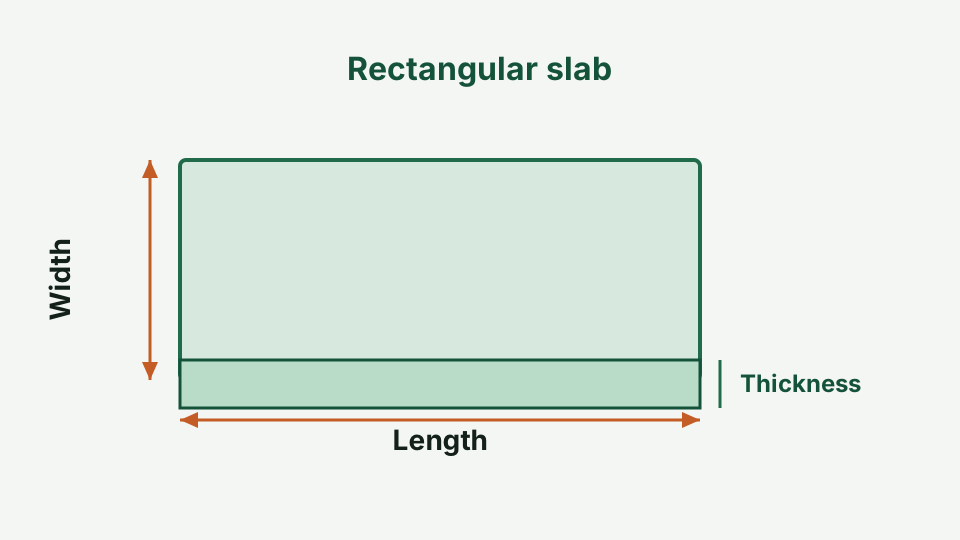
How it's calculated
Volume (cu ft) = 10 × 10 × (thickness_inches ÷ 12). Yards = cu ft ÷ 27. With waste: bags = ceil(cu ft × 1.10 ÷ yield) using ~0.60 cu ft per 80 lb bag and ~0.45 cu ft per 60 lb bag. At 4 inches, thickness in feet is 4÷12 = 0.333 ft, so volume = 100 × 0.333 = 33.3 cu ft. Multiplying by 1.10 gives 36.7 cu ft for ordering.
That bag math matches the same TypeScript formulas behind the on-site calculator—so the chart below should agree with what you see when you enter 10 × 10 × 4" with 10% waste.
Why do some older charts show fewer bags? They sometimes omit waste, use a different yield assumption, or round aggressively. If a chart says “about 45 bags” for this slab, look closely: 45 bags of 80 lb mix cover about 27 cu ft—one cubic yard with no waste—which is less than a 10×10×4" pour. Trust volume first, then bags.
Finish planning with access in mind. A 10×10 patio behind a narrow side yard may force wheelbarrow staging even if ready-mix is priced well. Conversely, a front-yard pad with truck access makes short-load ready-mix attractive once you pass roughly a yard. Price both options with the same waste assumption so the comparison is fair.
10×10 slab chart
| Thickness | Cu ft | Cu yd | 80 lb bags (+10%) | 60 lb bags (+10%) |
|---|---|---|---|---|
| 4" | 33.3 | 1.23 | ~62 | ~82 |
| 5" | 41.7 | 1.54 | ~77 | ~102 |
| 6" | 50.0 | 1.85 | ~92 | ~123 |
Other common patio sizes (4" thick, before waste)
| Size | Cu ft | Cu yd |
|---|---|---|
| 8×8 | 21.3 | 0.79 |
| 10×12 | 40.0 | 1.48 |
| 12×12 | 48.0 | 1.78 |
Near or above one cubic yard, ready-mix often wins on labor if a truck can access the site. Always compact a gravel base separately—base volume is not included in slab concrete. Estimate base with the gravel calculator.
Worked example: 10×10×4" with base
Concrete: 33.3 cu ft (1.23 cu yd) before waste → 36.7 cu ft with 10% → about sixty-two 80 lb bags. If you also place 4 inches of compacted gravel under the slab, gravel volume before waste is also 33.3 cu ft (1.23 cu yd). With 10% compaction/waste allowance ≈ 1.35 cu yd. At YardTally’s mid-range crushed-stone density (~2,700 lb/cu yd), that is on the order of 1.8 tons—confirm density with your yard.
Worked example: 10×10×6" shed pad
Heavier shed pads sometimes use 6 inches: 50 cu ft (1.85 cu yd) before waste → 55 cu ft with 10% → about ninety-two 80 lb bags or one hundred twenty-three 60 lb bags. At that bag count, price a short-load ready-mix truck against all-day mixing.
If the shed manufacturer specifies a thicker edge beam or pier footings under the skids, those volumes are additive. Sketch the thickened sections as separate rectangles, run the calculator once per section, and sum bags so you do not under-order the perimeter.
Tips
- Form the slab carefully; bowed forms steal concrete and ruin edges.
- Plan control joints—rule-of-thumb spacing is often discussed in residential guides as roughly 2–3 times the thickness in feet (for example, a 4-inch slab might see joints on the order of 8–12 ft), but follow local practice and ACI residential guidance.
- Dampening the subgrade helps in hot weather; avoid standing puddles.
- Order extra bags for steps or thickened edges if your design includes them—they are not in the flat 10×10 chart.
Common mistakes
- Forgetting waste and finishing one corner short.
- Including gravel depth inside the concrete thickness input.
- Using post-hole bag charts for a rectangular patio.
- Pouring on uncompacted fill that later settles and cracks the slab.
- Assuming 46 bags of 80 lb mix covers a 10×10×4" slab with waste—that under-orders versus 0.60 cu ft yields (you need about 62).
What goes under and around the slab
The chart on this page covers only the concrete itself. A well-built 10×10 patio or shed pad usually also involves a compacted gravel base, forms around the perimeter, and sometimes welded wire or rebar, depending on local practice and the load. Reinforcement keeps cracks tight rather than preventing them, and the spacing and size are design decisions best taken from your local code or a contractor for anything structural.
Where a new slab meets a house wall or an existing pad, builders commonly place an isolation or expansion joint material so the pieces can move independently. Skipping that detail is a frequent source of cracking at the contact line. Slope is another detail that is easy to forget: patios are typically given a slight fall away from the building so water drains, which means the concrete thickness at the high and low edges differs a little. Measure at several points and use the average thickness when you convert to cubic feet.
Finishing and curing take planning too. Once bleed water leaves the surface, the slab is floated and troweled or broom-finished for traction. A broom finish is common outdoors because it is less slippery when wet. Then keep the surface from drying out too fast. If you only have the helpers and mixer capacity to place a small section at a time, consider splitting the slab with a form divider so each pour can be finished before it sets.
When to call a pro / safety / codes
Hire a concrete contractor for driveway slabs, attached garage floors, structural foundations, or decorative finishes. Building departments often require permits for large pads and for any work tied to a structure. Reinforcement, vapor barriers, and thickness for vehicle loads must follow local code—not a volume chart. Wet concrete can burn skin; use PPE and keep children and pets away from the pour. This guide is for material estimating only.
Sources
FAQ
How much concrete do I need for a 10×10 slab at 4 inches?
About 33.3 cu ft or 1.23 cu yd before waste. With a 10% waste factor (YardTally default), that is about 36.7 cu ft—roughly 62 bags of 80 lb mix or 82 bags of 60 lb mix at standard yields.
How much for a 10×10 slab at 6 inches?
About 50 cu ft or 1.85 cu yd before waste. With 10% waste, expect roughly 92 bags of 80 lb mix or 123 bags of 60 lb mix. At that size, ready-mix is often more practical if access allows.
Does the slab volume include the gravel base?
No. Concrete volume is only the slab thickness. Compacted gravel or crushed-stone base is a separate order—estimate it with a gravel calculator using base depth, not slab thickness.
What thickness should a patio slab be?
Many residential patios and shed pads use about 4 inches of concrete over compacted base. Driveways and heavier loads often need 5–6 inches plus reinforcement details required by local code. This guide estimates volume only—it does not design structural thickness.
How do I convert a 10×10 slab to bags?
Compute cubic feet (10 × 10 × thickness in feet), multiply by 1.10 for a 10% waste allowance, then divide by bag yield (about 0.60 cu ft for 80 lb, 0.45 for 60 lb) and round up.
Related calculators
- Concrete Calculator — Slabs, footings, and solid steps with cubic yards and bag counts.
- Gravel Calculator — Driveway and path gravel in yards and tons.